What is Re-Victimization
When it comes to rape and sexual assault, there are a lot of subjects within it that people don't talk about enough. It's hard enough for people to discuss rape, but the details? With the lack of details, there's a lot of misinformation spreading, even for survivors themselves. While Survivor Sparks is all about educating the public, we also need to inform survivors. The common consensus is that people believe if you've been raped once, it won't happen again. They ask, "Why would you put yourself in that situation again?" Well, there's something called sexual assault revictimization, and it's about time we talk about it.
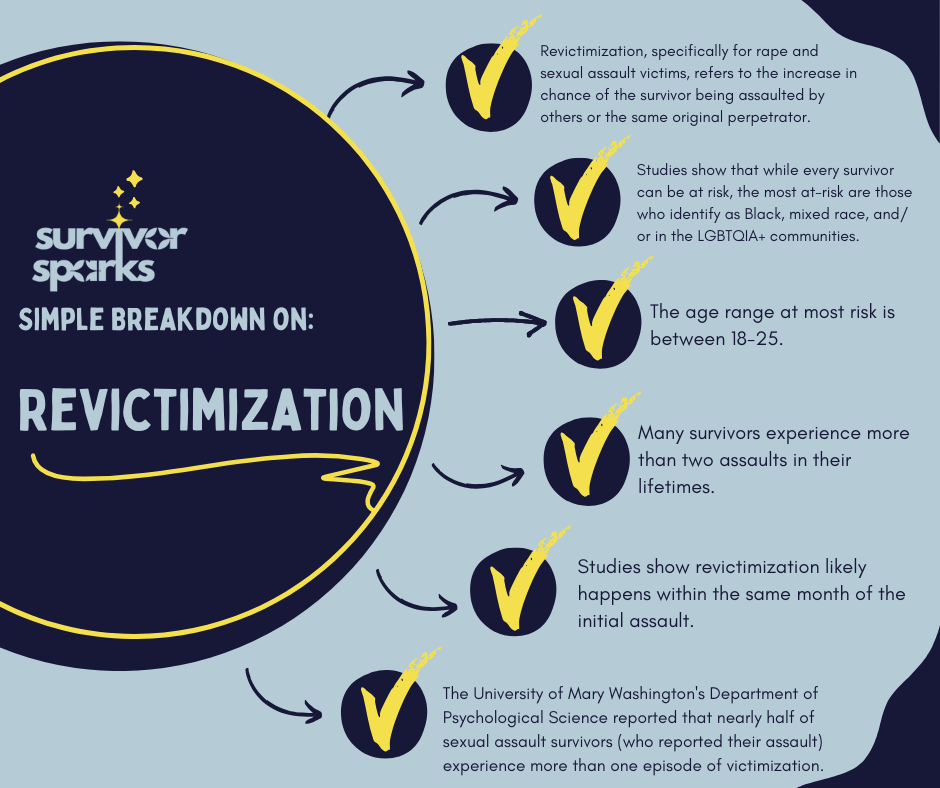
Revictimization, specifically for rape and sexual assault victims, refers to the increased chance of the survivor being assaulted by others or the same original perpetrator. In the simplest terms, it means if you've been assaulted before, the chances are higher that it could happen again. (The most common type is when it happens when you were a child, 0-18, and having it happen again as an adult.)
Everyone is quick to mention the PTSD, depression, and isolation that come from being a survivor. But being a survivor more than once? It's kinda crickets, but it happens, and it happens a lot.
The University of Mary Washington's Department of Psychological Science reported that nearly half of sexual assault survivors (who reported their assault) experience more than one episode of victimization. This isn't even counting the millions who haven't reported, so keep in mind that this number could be even higher.
Who in the survivor community is most affected? Well, the California Center of Excellence for Trauma-Informed Care revealed that there are high rates across all races, but noted there seemed to be a higher amount with survivors identifying as Black or of mixed race, or those who identify in the LGBTQIA+ community. And as for age, experts noted that the age range for the most elevated risk for revictimization is around ages 18 to 25, also known as the time of experiencing adulthood for the first time and personal exploration.
Experts also found in their studies a few other discoveries to note: Oftentimes, but most certainly not every time, revictimization likely happens within the same month of the initial assault, and it's twice as likely to happen to survivors who haven't acknowledged their past assault.
Revictimization is still not down to a science, much like many facets of being a survivor. There's no one-size-fits-all approach to dealing with the aftermath. Revictimization is real, and many survivors experience more than two assaults. I, myself, have experienced it with four past partners, one of whom assaulted me over and over again. It's a cycle, and it may seem impossible to get out of, but you can.
While experts don't know effective interventions to stop revictimization before it happens in a cyclical manner, they know it can be stopped. Revictimization is more common than you think, so talk to a support group, a therapist, or someone you trust to discuss this. Some break the cycle by luck, and some have to put in the work, but know you can do it. The cycle can end.