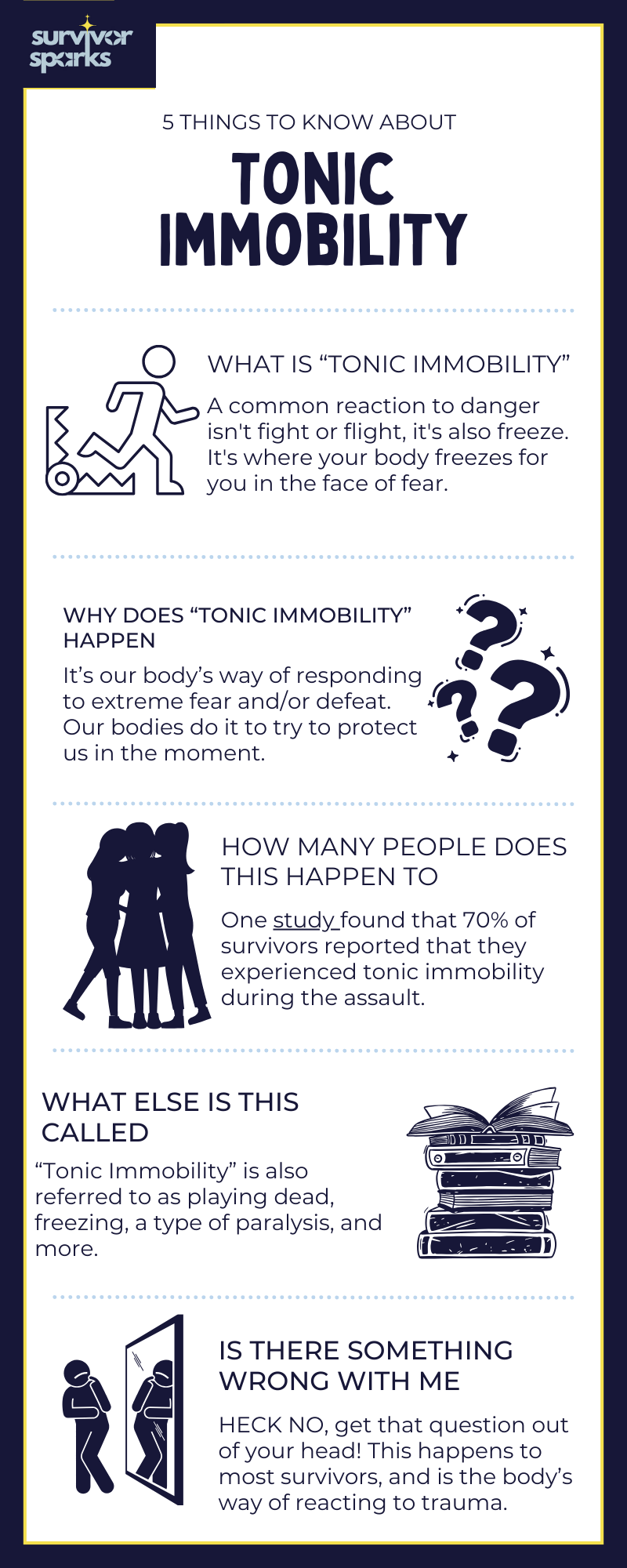
Fight, Flight, & Freeze
“Why didn’t she fight back?” “Why didn’t he throw a punch?” “Why did they freeze? Isn’t fight or flight a thing?” While we all know about the “fight or flight response,” both survivors and experts alike agree it should be reformed. The concept of “fight or flight” should become more accurate, so we’re going to talk about “fight, flight, or freeze.”
A common reaction to danger, especially in the face of sexual violence, isn't fight or flight; it's also freeze. It's where your body freezes for you in the face of fear. Freezing is also referred to as playing dead, rape paralysis, and even “tonic immobility,” which is what we’ll use to refer to for the rest of the piece.
Now, why does “tonic immobility” happen? Simply put, it’s our body's way of responding to extreme fear and/or defeat. It’s a way for our bodies to try to protect us in the moment. During this paralysis, you can’t say anything or do anything until you feel safe enough again. It’s a reflex, a reaction. It’s survival, and it’s something that happens way more than people are willing to talk about.
In fact, one study from the Department of Clinical Science and Education at the Karolinska Institute in Stockholm, Sweden, found that 70% of survivors reported that they experienced tonic immobility during the assault. Nearly 50% of the women who were part of the study also discussed having “extreme tonic immobility” during the assault. From this rare study, they found that two-thirds of the women developed PTSD.
“Tonic Immobility” is an involuntary response. I know, you may look back and say, “I should have fought back,” but your body was trying its best to protect you. I know firsthand the guilt and the questions that come with it, but remember, it’s not our fault. So many survivors face this, and it happens more than people want to believe.